Named after the debut single by Teenage Fanclub.
This blog is all about being a music lover in Glasgow; reviews, interviews, memories, old faves, new discoveries (past and present), playlists and more. Thanks for visiting - I hope you discover something amazing you have never heard before, or that you rediscover an old favourite.
Regular features/playlists; Never Ending Mixtape / Cover Version of the Month/ Trust Me.
Insta - @everythingflowsglasgow
Showing posts with label Glasgow Film Theatre. Show all posts
Showing posts with label Glasgow Film Theatre. Show all posts
Last night I attended the Glasgow premiere of The Possibilities Are Endless, the new film/documentary on the recovery of Edwyn Collins from a major cerebral haemorrhage in 2005.
As a fan of Edwyn's music, having seen the trailer and read Grace Maxwell's fantastic and deeply personal book Falling and Laughing - The Restoration of Edwyn Collins, I was very keen to see the film at the GFT - especially with the added bonus of a Q&A and short acoustic set afterwards.
The Possibilities Are Endless is a fascinating, beautiful, artistic and moving film, directed with thought, empathy and a real creative flair by Pulse Films.
We are placed inside Edwyn's mind as he wakes from his stroke - the confusion is evident, illustrated by shots of a young boy seemingly drowning, the wind blowing through the grass, a storm brewing, distorted and stuttering words.
There was a Q&A with Edwin, Grace and Ed from Pulse afterwards and the audience learned of how Pulse interviewed Edwyn first (with no cameras), before considering how to set the story to film. Possibly a risky tactic, but one they have pulled off superbly.
At the heart of the film lies a love story, the love between Grace and Edwyn and also that of their love for Helmsdale in the north of Scotland where they are moving to.
There are lovely scenes of them walking through a park and sharing a can of ginger beer, Grace looking on with care as Edwyn attempts to find the words he knows are in there during an interview and the pair of them laughing in a car as they drive to their beloved Helmsdale in the north of Scotland. Grace's encouragement and patience was crucial to Edwyn's recovery.
We learn of how Edwyn could only say 'The possibilities are endless' and 'Grace Maxwell' when he woke from a coma. There is a great TV interview with Edwyn and Grace that ends with Grace strumming Edwyn's guitar as he plays the chords and emotional footage of the moment he returned to the stage.
Throughout the film there are scenes of Edwyn in his Orange Juice days, at his peak (sales wise at least) with the success of A Girl Like You. These work in tandem with the scenes of Edwyn regaining his strength and skills - writing, drawing, singing and creating.
There is humour as well - Edwyn and Grace bounce of each other with real affection that you can't help but smile at times and laugh at others.
What I got from the film is that the possibilities are endless if you have love and support. Edwyn is very lucky to have a lovely partner and the help and support of family, friends and musicians. It's a life affirming film that makes you stop and take stock of your health and those that care about you. I would thoroughly recommend catching it on the big screen if possible or downloading it from iTunes now.
Last night Lynn and I
enjoyed a rare midweek 'date' to the pictures, the lovely Glasgow Film
Theatre, to see 'Shut Up And Play The Hits', a documentary about the end
of LCD Soundsystem, centred around their final epic show at Madison
Square Gardens.
We arrived at the GFT a full hour before the 8.40pm showing. With the knowledge that it was a sell-out we wanted to get a couple of drinks in the bar and good seats.
In the lead up to the main fetaure we were 'treated' to some 'live from the red carpet' footage from the premier in the Hackney Empire in London. A rather enthusiastic and annoying presented caught up with Al Doyle (Hot Chip and LCD), James from the Klaxons, the producers and some fans, some of whom must have been set up.
Anyway, eventually (and this may have been meant) we did get to the stage where the audience were thinking 'Shut Up And Play The Hits'.
This flashes up at the start of the film and kind of sets the tone for the concert side of things; an epic celebration of the music and idealism of LCD Soundsystem during a 4-hour show to a sell-out crowd of 18,000 people at Madison Square Garden.
It is the party to end all parties, champage, special guests like Arcade Fire on backing vocals for 'North American Scum', balloons from the roof, music, dancing and romancing (some great footage of a couple lost in music and each other with a big kiss at one point).
The celebration side of things is balanced by the complete come-down captured in the immediate aftermath of the show. I loved the way that this was portrayed. We had Murphy waking up in his cool NYC loft apartment still wearing his shirt from the night before, cuddling his dog, taking his dog out for a piss, feeding his dog, shaving, listening to answer phone messages, riding the subway, going to his office and basically wondering what the hell he was going to do with his life.
This in itself was counter-balanced by footage of Murphy being interviewed by an extremely inquisitive American journalist. It worked exceptionally well with Murphy being equally humourous and extremely open about his thoughts and feelings.
The concert footage is fantastic. The producers capture how cavernous the venue is, the roof looks like it is a giant space station, the crowd is vast, yet on stage LCD Soundsystem make it seem intimate by all grouping together surrounded by various banks of equipment.
'All My Friends' is dropped early doors to a round of applause by the audience. The footage from Madison Square Gardens slowly but surely becomes more euphoric as the party goes on; 'Movement' and 'Us and Them' capture the band merging punk, funk, techno, electro, garage and psych all at once - the beauty of LCD.
Footage cuts starkly and dramatically to post-concert dressing room scenes, to Murphy riding the subway or getting a car back to his flat gazing out at the New York skyline, the comedown setting in already.
In the interview we learn that Murphy is in his early 40's and wants to settle down and have kids. He is worried about the effect that touring has on him, stating that in the 2-years he didn't tour between 'Sound Of Silver' and 'This Is Happening' that he didn't get a single grey hair but as soon as he went on the road for the last time he started getting greyer and he wondered what this was doing to him on the inside.
We also learn of Murphy's satisfaction in practically everything LCD and DFA Records have recorded and released and that after 3 albums he wants to end on a high. He likes the fact that he is 'moderately successful', not overly successful/famous, he likes that he can walk his dog and ride the subway.
Some of the camera shots and positioning for the concert footage are incredible, different enough to make it original. So we have the brilliant footage of the mosh pit from directly above, cameras between amps and keyboards, in the crowd, in the photo pit....all capturing the experience.
'Losing My Edge' is predictably brilliant with Murphy also talking about how much it means to him and although people see humour in it, he was talking from the heart. He'd been playing The Stooges while high on E, mixing everything up from his considerable collection (some great shots of that in the flat scenes), now kids were coming up from behind and he was feeling threatened.
Murphy wanders from his office to the LCD storage space to check everything is in. This is probably my favourite scene in the movie, it tugs on the heartstrings. Murphy looks on at the equipment the band have built up, the thoughts running through his mind must have been similar to what were going through my mind. He was thinking of the memories, the music that has been made and played, the good times... and he cries.
This was the funeral scene, the realisation that the band had died. The concert had been the celebration. Murphy was now in mourning.
The film ends with LCD Soundsystem playing 'New York I Love You But You're Bringing Me Down' cutting to footage of the band having a dinner in a hip New York restaurant, drinking, sharing memories.
Thanks for the memories James. I hope there is more to come.
Yesterday I headed along to the Glasgow Film Theatre for the world premiere of ‘Serious Drugs’, a film/documentary about the cult guitar pop band, The BMX Bandits.
The producer is a guy called Jim Burns who discovered the music of the Bandits during a period of very heavy depression in his life. The revealing Q & A at the end of the film saw Jim really open up about this, describing a time when he was ‘emotionally numb’, he couldn’t feel anything good or bad. Yet somehow, the music of the BMX Bandits broke through the ‘numbness’ and reached Jim.
So Jim set about trying to discover ‘who or what are the BMX Bandits’, ‘what makes a BMX Bandit’ and ‘why can the songs of the BMX Bandits reach me when I am so down?’
The answer comes in the form of the leader of the BMX Bandits, Duglas T Stewart. The film, an incredibly personal project for Burns who funded the film himself, was shot over a 4-year period following Stewart and his fellow Bandits, interspersed with rare footage and photos from the Bandits career.
The Q&A at the end was relatively short, but it revealed a great deal. Burns had never picked up a camera before, let alone attempt (or even think about) making a film. That innocence probably helped to make the film as special as it is. It is clear from the start that there are no barriers between the band and Jim, he is accepted. Indeed Jim did say at the end of the Q&A that this is ‘the closest he will ever get to be in a band.’
To many people, the BMX Bandits are essentially Duglas T Stewart and he is naturally the focus for the film. However, throughout the film Duglas is very keen to highlight the importance of his fellow Bandits and how important they are to allow him to create the music he hears in his head.
There is a great bit in the film where Duglas is creating a very colourful and neat BMX Bandits family tree. Norman Blake (Teenage Fanclub), Eugene Kelly (The Vaselines, Eugenius), Sean Dickson (Soup Dragons), Francis MacDonald (Teenage Fanclub) and David Scott (The Pearlfishers) are just some of the names that have contributed to the 25-years of music by the Bandits. Duglas may be the lead Bandit, but he realises the importance of his fellow Bandits.
The film takes us on a 25-year rollercoaster, discovering Stewart’s ability and desire to perform at an early age. Duglas reveals how he used to be taken around the classes at school to perform impressions and how he was particularly good at Frank Spencer! Early pictures of the Bandits show them busking in Sauchiehall Street with Duglas’ performance generating large crowds. There is also grainy footage from someone’s living room and back garden, everyone is always smiling, a feature that continues to this present day, regardless of who is involved with the band.
Humour is evident throughout the film, whether it is direct from Duglas, or via the producer. Nice words and reviews from the likes of Kurt Cobain, Sounds and the NME are shown directly before reviews that pan the Bandits. There is a hilarious interview where someone asks a young Duglas about being a sex symbol, some good stuff from Alan McGee and Duglas is on top form throughout, whether comic or candid.
It is all relatively good fun until the release of the single ‘Serious Drugs’. The film suddenly changes from being about a fun guitar pop band to commenting on depression. Stewart reveals how he was on medication when he met a new girlfriend and she told him she didn’t think he needed it. 3-weeks later she was saying that his medication could be stronger, hence the line ‘I said I don’t think I can take it much longer, she said ‘maybe your tablet should be stronger, get some serious drugs’, I need some serious love.’
I originally anticipated Jim Burns being shown in the film and talking about his own depression. Instead he allows Duglas to reflect on his own, which in turn reflects on Jim’s.
My personal highlight from the film is probably the scene where Duglas is in his kitchen making Cheese & Toast, a very un rock’n’roll (and therefore a very BMX Bandits) thing to do. It is late at night and Duglas can’t sleep. He has been warned that cheese can bring nightmares, yet he finds that it brings him good dreams, so he continues to make cheese and toast at night. Duglas pours his heart into his songs, he lays himself bare. So he writes a song called ‘Cheese & Toast’. The song is on the 2006 album ‘My Chain’, the album that got Jim Burns into the BMX Bandits.
The last two Bandits albums have really seen them develop and mature. The lovingly endearing ramshackle guitar pop of debut single ‘E102’ has grown into brilliant pop, but in a more Beach Boys (Brian Wilson is a hero for Stewart) vein. The layers, harmonies and musical ability of the band has developed (as you would imagine over 25-years) considerably. Despite this, many of the media still view BMX Bandits as some kind of joke group. Something referred to a few times throughout the film.
I can only hope that this film may readdress that. Stewart writes songs about love, life and hope. Simple, yet powerful, funny at times, moving at others.
The last two albums have seen the addition of Rachel Allison (vocals) and David Scott (keys and many other things) and they seem to have helped inspire Stewart to some of his best work to date. Not that he can’t rely on others to help when it comes to the Bandits.
Norman Blake, Stewart’s great friend, features throughout the film and towards the end he likens being a BMX Bandit to being an Army Reserve; ‘you could get called up any time.’ Indeed Blake features on stage at the Bandits 25th anniversary show at Oran Mor in January 2011, a few songs are included in the film.
So how would you summarise Serious Drugs? Well, it is kind of like the Bandits; There is more than a splash of humour and fun, it is one man’s vision – yet with the help of others, there are many layers to it and ultimately it may prove to have a cult audience.
I was tempted to ask Jim at the Q&A at the end what he intends to do with the film now. However I opted not to. He is taking a well deserved holiday and he has seen the result of 4-years of work with his favourite band displayed on the big screen in his favourite cinema surrounded by family, friends and fans.
I do hope that Jim finds the time and energy to take this further – would BBC Scotland/BBC3 show the film? Could he take it to some independent film festivals?
Anyway, Jim has captured the spirit of one of Scotland's most endearing bands and artists. I look forward to hearing what Duglas and the Bandits come up with next.
Last night I headed along to the Glasgow Film Theatre to watch the 'For One Night Only' screening of the new Martin Scorsese documentary on George Harrison; 'Living In The Material World'.
I arrived at 6pm and treated myself to a lovely pint of Munich Red from the Glasgow brewery WEST as I met up with my sister and our friend Deborah. The queue was already forming, so we joined to ensure we got decent seats. Before long it was doubled back and out the door, Beatlemania is alive and well in Glasgow in 2011.
After a few trailers the film started. Scorsese spliced footage from the Second World War (George was born in 1943) with popular tunes from the time, quickly building up to the formation of The Beatles.
Paul McCartney told the story of how George joined after an audtion on a double-decker bus, riding round Liverpool at night. There was some excellent footage from their Hamburg adventure that happened when George was only 17-years old. He must have grown up fast!
The Hamburg footage cut to interviews with Astrid Kirchherr and Klaus Voormann. We didn't learn anything new but Astrid allowes some very rare photos of John and George at the site of Stuart Sutcliffe's death to be shown. They were very moving.
Klaus popped up regularly throughout the film and you could tell that his bond with George was particularly strong.
We got caught up in the whirlwind that was Beatlemania and Scorsese worked his magic at times, particularly when The Beatles were in Australia and he somehow spliced pictures taken by George with footage as well, top marks to the researchers.
George dismissed his first Beatles song 'Don't Bother Me', but he realised that songwriting and publishing was the future and formed Harrisongs.
It was quite astonishing to watch Harrison's songwriting skills develop on the big screen. 'If I Needed Someone' , 'Taxman', 'Within You Without You', 'While My Guitar Gently Weeps' (featuring his mate Eric Clapton) and on to the astonishing 'Something' and 'Here Comes The Sun'.
Harrison's personal photo and video library was plundered to astonishing effect, the highlight would have to be footage of George and Paul signing reams of documents to finalise the break up of The Beatles. It left me and my fellow Beatle enthusiasts Stephen and Craig (from Sonny Marvello) wondering what Macca has stored away.
Ringo appeared regularly and often to great laughter (the highlight was a joint interview from the 80's during which George said he stopped 'discotequing' in the 60's and Ringo responded, taking the piss, by saying he stopped 'discotequing' in 1980) amongst the crowd and he highlighted how it was McCartney that kept The Beatles going after the death of Brian Epstein. Something that is often overlooked.
There were some very frank interviews with Patti Boyd and Eric Clapton, with Boyd admitting that Clapton's stunning 'Layla' won her over. Clapton came across as a bit of a wanker at this point, pinching his beat friends gorgeous wife and playing it off on sixties swinging and free love. Harrison seemed to be a bit of a womaniser himself to be fair.
On to the solo years with Neil Aspinall confirming that George had been stockpiling songs that culminated in the astonishing 'All Things Must Pass' double album. The songs sounded fresh and vital, blasting out on the GFT speakers.
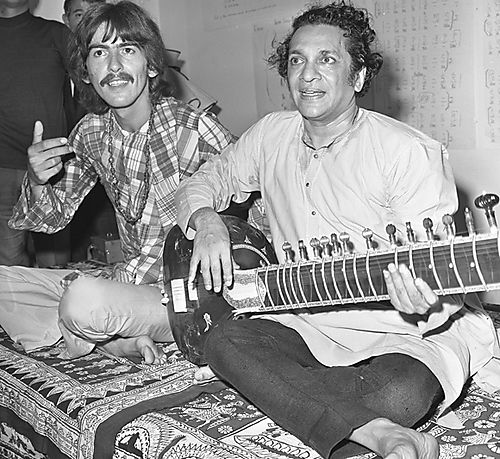
George hooked up with Ravi Shanker in the 60's and the pair became life long friends, leading to George's amazing 'Concert for Bangladesh' and there was some fantastic footage from the concert.
Phil Spector was interviewed to the amusement of the crowd, the genuis producer remarked on how shambloic it had all been and he had to literally drag Dylan from his apartment to play.
Harrison's 'lost years' were glossed over somewhat, but the use of heavy drugs was hinted at.
Olivia Harrison gave some very personal interviews, emotional and revealing. She admitted that George was far from a saint and that the secret of a good marriage was ' not to get divorced'.
Humour was apparent all through the film and my own personal favourite was footage of Macca visiting George (mid 90's I reckon) and coming into the room wearing a leather jacket only for George to immediately rip the piss out of him with; 'Is that a vegetarian leather jacket?'
Considerable time was devoted to George's own devotion to meditation and Hare Krishna. In later years we learned of how he was ultimately preparing for his own death and that he was determined to leave in the right way.
So much happened in George's life, this review hasn't even touched on his importance to British comedy and his bankrolling of Python's 'The Life of Brian' and other films he got involved with.
George's humour and natural warmth touched his friends to a great extent. He was never afraid to show his love and how her cared. There were some very touching stories about George's friendship, it all came naturally to him.
George's battle with cancer and the horrendous attack on him in his own home received coverage, including a rather graphic blow by blow account by Olivia.
Ultimately, the film showed the remarkable rise of a young man from Liverpool with confidence in his ability as an artist and as a person. George's life touched millions around the world. Scorsese's documentary allowed us to hear from some of the people he touched the most.